
Online Workshop (2-3 December, 2025): Conceptual Engineering in the World History of Mathematics
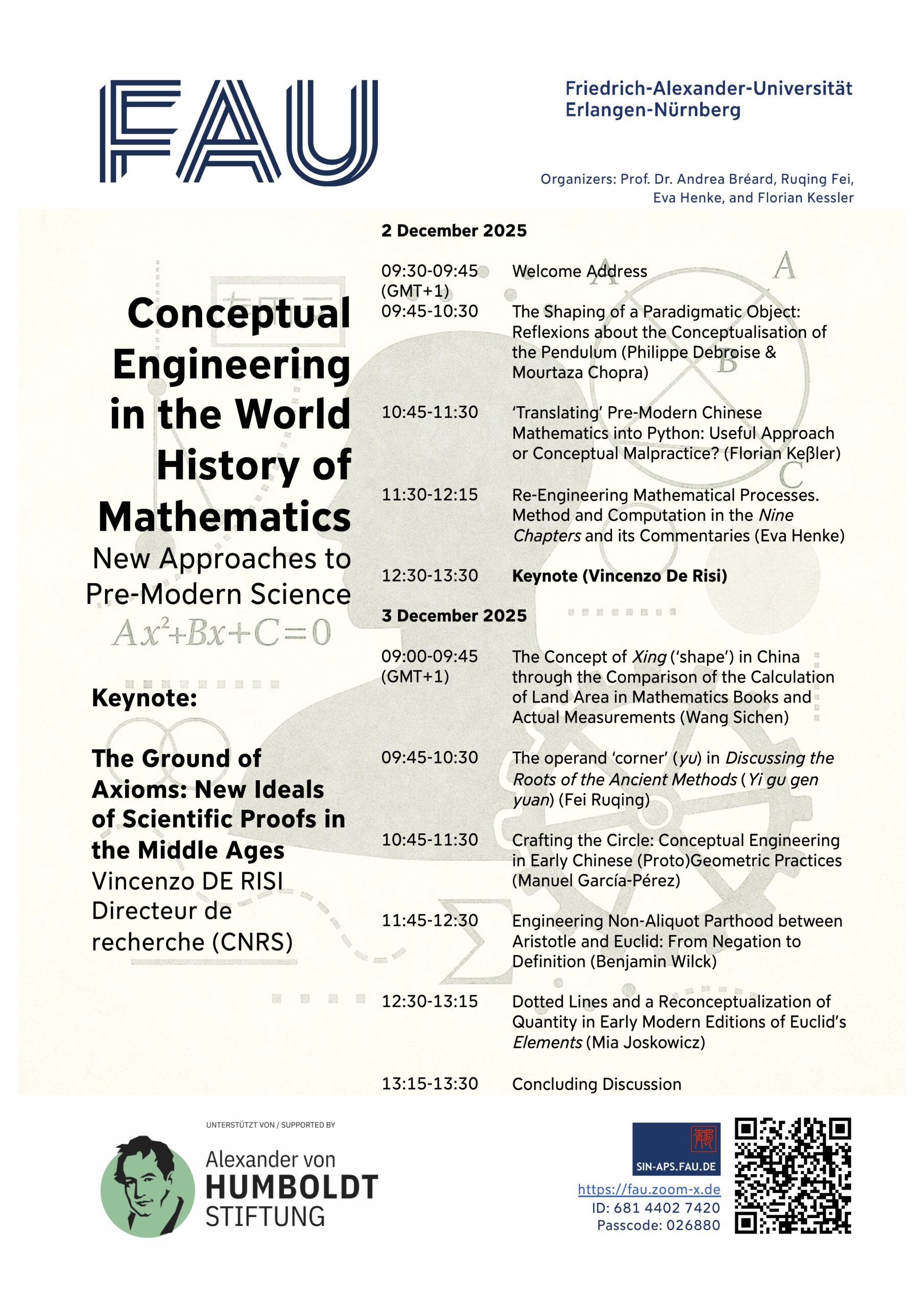
In this workshop, hosted by sin-aps and generously supported by the Alexander von Humboldt Foundation, we will approach the global pre-modern history of mathematical concepts in a new light. Dr. Vincenzo de Risi (CNRS, Paris) will give the keynote talk on The Ground of Axioms: New Ideals of Scientific Proofs in the Middle Ages.
As KITCHER (1984) has observed, “One of the principal obstacles to a satisfactory account of scientific knowledge has been the difficulty of understanding conceptual change in science”. Since conceptual change doesn’t happen by itself but is driven by humans, this raises the fundamental question: how consciously did they shape concepts as creative agents? Did they react to perceived flaws or gaps? What did they do to create, revise and implement concepts? On a more meta-level, we can also ask whether historians of mathematics create or redefine mathematical concepts. For example, when tracing the development of a mathematical theory or comparing texts from different places, historians need to do justice to a wide range of practices. This may require them to adjust concepts like “negative number”, “proof” or “abstraction”.
In recent years such conscious efforts to devise and revise concepts have been discussed under the title of “conceptual engineering”. Following CHALMERS (2020), we can understand conceptual engineering as a process consisting of the design, evaluation and implementation of concepts. Design can mean for example giving a definition or paradigm cases either for a new concept or for an old concept which is understood in a new way. After the merits and disadvantages of the new concept are evaluated further adjustments may be made. To implement a concept means to use it and potentially, to make others use it as well.
- CHALMERS , David J. 2020. “What is conceptual engineering and what should it be?”. Inquiry, 1–18.
- KITCHER , Philip. 1984. The Nature of Mathematical Knowledge. New York & Oxford: Oxford University Press.
For more details, see the poster.